We already knew there was a hen called Tiny Enid. Now it has come to my attention that, in the USA, there is a Dalmatian puppy also named after the plucky tot. Matt and Mandy (whomsoever they may be) are to be congratulated on their excellent pet-naming skills. Visit their Drop My Straw blog and you can see both a photo and a video of the canine Tiny Enid.
Archive for the 'Tiny Enid' Category
Page 2 of 3
There is a pavilion by the shore. I do not go there any more. I used to visit every day on my clomping horse with its rattling dray, and I’d hammer my fists upon the door of the pavilion set beside the shore, but I do not go there any more. I cannot go there any more.
I used to clomp along the lane lined by beech and larch and plane, but something went wrong in my brain and now I languish in the drain.
I languish in a drainage ditch. I’m smeared with grease and tar and pitch. I’ve lost the use of my lower limbs and at the mercy of vermin’s whims.
All sorts of vermin suck my blood as I lie sprawling in the mud, and others gnaw my skin and bones while I groan my dramatic groans.
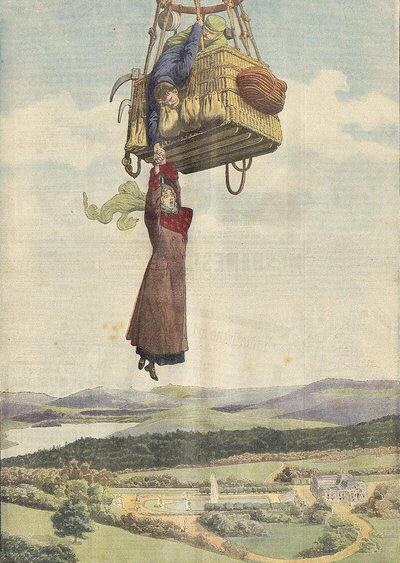
Above me, a hot air balloon will be arriving very soon. I’ll be winched up by a length of rope, and washed with disinfectant soap.
The balloonist will sing rousing hymns to cure my withered lower limbs, and we’ll hover in the boundless sky eating a snack of lemon meringue pie.
Then I’ll be dumped back on the lane, a few tweaks putting right my brain, and then I shall return once more to the bright pavilion by the shore.
I’m sure there’s something, before I go, that you are very keen to know. The balloonist’s name – don’t be a clot! It was Tiny Enid, the heroic tot!Â
During one of her thrilling adventures – it may have been the time when she rescued some ducks from a toxic puddle – Tiny Enid suffered a clonk on the head. Thereafter, every so often, she began to have visions, and she became convinced that she was seeing tableaux from her previous lives. It had never before occurred to the plucky tot that she might have lived before, under other guises, and that “Tiny Enid” was but one character her Gaar, or essence of being, had inhabited. Her mysterious mentor, whom we have a very vague picture of from earlier Tiny Enid adventure stories, pooh-poohed her visions and recommended that she eat heartier breakfasts, but Tiny Enid was wedded to her morning milk slops and had an independent spirit. Although she valued her mysterious mentor’s sage counsel, she also thought him a bit of a doddery old foolish person, and she picked and chose which pieces of advice to follow. In many ways Tiny Enid’s personality was akin to that of Charles Lindbergh, the aviation ace, daring and reckless and with a fascist bent. Chronologically, of course, it was impossible that Tiny Enid could be the reincarnation of Lindbergh, and in any case, in all her past life hallucinations she was a girl. Most of the time, too, she was tiny.
Contemporary fans of the heroic infant, those who keep her memory alive, often seem embarrassed by this aspect of Tiny Enid’s character. They prefer to think of her as level-headed and no-nonsense and gritty, and of course she was all these, but drawing a veil over her post-head-clonk belief in various types of ethereal woo does her a disservice. To see Tiny Enid in the round is to accept that she thought her Gaar was as real as a pebble she could hold in her hand and as important as a telegram alerting her to the imperilment of some ducks in a toxic puddle.
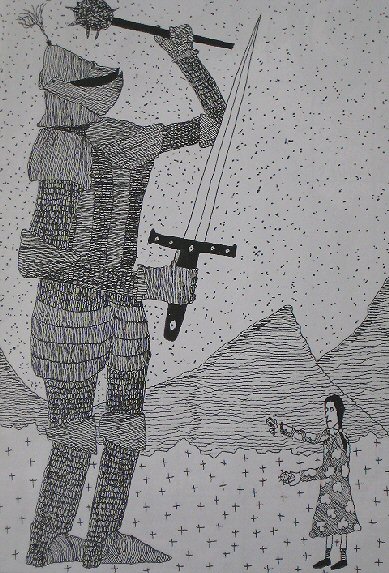
One Tiny Enidist who is keen to pay due attention to this sort of guff is Basil Groove. The name may be familiar to those of you who grooved to the fab sounds of the sixties, for Basil was a member of the psychedelic pop group Turquoise Eye Of The Lobster King. Having hung up his plectrum, Basil Groove has been scouring the world’s picture libraries seeking illustrations which depict figures who may be Tiny Enid avant l’Enid, as it were. He has compiled these into an album to be published later this year, entitled Scenes From The Past Lives Of Plucky Tot Tiny Enid, and it is with great pleasure that we are able to show one of the drawings here. It shows a small female child, armed only with a pin-cushion and a pencil sharpener, confronting a dreadful knight. She may not have a club foot, but, as Basil Groove says, “who else could this possibly be than the fearless infant heroine whose venturesomeness delights us all?”
One misty morning, Tiny Enid was reading the latest issue of her favourite comic, The Ipsy Pipsy Woo, when, in a speech bubble hovering over the head of a character called the Very Reverend Prebendary Septimus Widdecombe, she came upon the words “the dustbin of history”. Specifically, she learned that every now and then there were people or institutions or events that were consigned to this dustbin. Tiny Enid thought this was a very sad state of affairs, but she was not a mawkish weepy kind of girl, so she did not sob into a napkin.
A helpful footnote in the comic explained that the existence of the dustbin was first revealed by a beardy bespectacled Russian revolutionary who ended up with an ice-pick in his head. Such a gruesome fate did not bother Tiny Enid one iota, for she could herself be ruthless as occasion demanded. She was alarmed, however, to read that the dustbin might not be a dustbin but a mistranslation of ash heap. If that which was consigned to it was incinerated, she reasoned that it would be beyond salvage. For already, you see, being the impetuous infant adventuress she was, Tiny Enid had decided to find the location of the dustbin of history and to rescue its contents. This seemed exactly the kind of mission for a plucky youngster who had been twiddling her thumbs in idleness for an entire fortnight, without a single daring escapade to speak of.
Casting The Ipsy Pipsy Woo aside, Tiny Enid took down an atlas from the bookcase. It was such a huge atlas that it probably weighed more than she did, but she managed to slam it down on to her lectern. The lectern was a full size one, donated to Tiny Enid by a grateful vicar whom she had rescued from the jaws of death in the jungle where he had a bit part in a Werner Herzog film, and she had to saw off part of the base to make it just the right height for her diminutive stature. Deciding not to worry overmuch about whether the dustbin was actually an ash heap, she skimmed hurriedly through the atlas looking for places where a pretty large dustbin or ash heap might be concealed. Although neither the speech bubble nor the footnote in her comic suggested that the dustbin of history was hidden away somewhere, Tiny Enid intuitively felt that must be the case, and she often relied on her intuition, which, as she explained to those who asked her, was not feminine intuition so much as heroic club-footed infant intuition, a different kind of intuition entirely, and far more accurate. It was, after all, her intuition which led the brave tot to track down the vicar on location in the jungle with Werner Herzog rather than, say, elsewhere with a director such as Jean Luc Godard or Guy Ritchie.
Pinpointing a large, flat, windy and uninhabited area on one of the continents, Tiny Enid packed her pippy bag with supplies and vroomed off in her jalopy towards the aerodrome, terrifying geese and ducks and roadside mendicants as she drove pell-mell along the winding country lanes. Hopping into her bi-plane, she roared away, out of the mist and up into the immense blue firmament, begoggled and begloved and chewing on a radish. She thought it would be a good idea to contact her mysterious unseen mentor to let him know what she was up to. We first encountered this mentor in an earlier story where he was introduced for intricate plotting purposes, without any clear idea of his identity. No need to worry about that now, however, for when Tiny Enid reached for the pneumatic speaking funnel she realised it was clogged with dust and pebbles. Even if she did manage to get a signal, all her mysterious mentor would hear from her would be mangled mufflement. She threw the funnel aside and revved her engines with renewed derring-do.
There was much turbulence during the flight, and much turbulence too inside Tiny Enid’s head. We think of her as a self-possessed and unflappable heroine, and she was, but often that resolute exterior masked inner turmoil. Like any of us, Tiny Enid was subject to entrancements and ecstasies, to sloshes of despair and to cranial hullabaloo. Weirdly, rather than planning what she would do if the dustbin of history turned out, after all, to be an ash heap, and an ash heap in a flat windy area where the ashes would be blown and scattered, she was instead mulling over something else she had read in that week’s Ipsy Pipsy Woo. In his weekly column, Father Ninian Tweakling had set a moral conundrum. Faced with the choice, which would you save from a burning tower – a half-starved yet impossibly cute puppy, or the horned and cloven-hooved incarnation of the Devil himself? This was precisely the kind of daring rescue Tiny Enid could imagine herself making one day, but she had to discount her immediate response, which was that she would cleverly extinguish the fire, carry the puppy directly to a dog hospice, and return to save the Devil, but bind him in chains and make him promise to mend his ways. Father Tweakling made plain that there was a choice to be made, between puppy and Beelzebub, and a great moral lesson to be derived from the making of it. Tiny Enid had been turning it over in her mind for a couple of days now, and it continued to busy her brain as she soared through the sky towards where she hoped she would find the dustbin of history.
She had still not come up with an answer when she brought the bi-plane down on to a landing strip attached to an apricot pericarp testing station. From here, she would have to hike across the plains, but first she stopped in at the station and asked the fruit scientist based there to give her a cup of tea.
“Tell me,” she asked in her shrill, fearless way, “Am I right in thinking that about fifty miles west of here across the plains I will find an enormous dustbin?”
The fruit scientist paused in his tea making, fixed the plucky tot with a watery gaze, and said, “Ah now, miss, some say as there is and some say as there ain’t. And me, I wouldn’t rightly know neither way. Milk?”
“You speak more like a bumpkin than a fruit scientist, sir!” shouted Tiny Enid, “And yes please, milk in my tea, thank you.”
Even though she was irritated by the fruit scientist’s semiliterate drivel, Tiny Enid never forgot her manners.
“Why might you be looking for a big dustbin all the ways out here then, little one?” asked the fruit scientist.
“Because, O man of apricot pericarps, I am resolute and intrepid,” replied our heroine.
And soon enough, as good as her word, Tiny Enid was on her way across the plains. As she thumped her way westwards, she wondered if the fruit scientist had been putting on an act in a misguided attempt to warn her off. Could the dustbin of history be a dangerous dustbin? If it was, Tiny Enid would be not cowed, she would snub her nose at it and carry on regardless, for she was frightened of nothing. She stopped at a place that was a bit less flat and windy than the rest of the plains and sat and smoked a cheroot, taking from her pippy bag the gazetteer she had packed earlier. Consulting the index, she saw that there were entries for neither Ash heap nor Dustbin but under History she found an illuminating survey of everything that had happened upon the plains for the last thousand years, from the battle of the boppityheads to the hunting to near extinction of the lopwit to droughts and floods and windiness to the establishment of the apricot pericarp testing station. It was all very interesting, and Tiny Enid lodged it in her memory banks. One day, she knew, she would no longer be tiny, and adventure would lose its allure, and she pictured herself grown and a bit dotty, sitting in a cottage writing her memoirs, and she wanted to forget nothing, for she was determined that she herself would never be dropped into the dustbin of history.
And then she sat up with a start. It suddenly occurred to her that, when she found the dustbin, and peered down over its edge, she might lose her footing and topple into it! Perhaps it had a greasy rim, or lethal uneven patches where it had been gnawed by wild animals. She rummaged in her pippy bag and blasted the heavens that she had not brought a goodly length of mountaineer’s rope and clambering hooks. Well, she had faced peril before and would face peril again. Stubbing out her cheroot and crushing it under her corrective boot, she pressed on into the west.
The sun was sinking when Tiny Enid arrived at a compound surrounded by a security fence. She smiled to herself at the thought that, though she may have neglected to bring mountaineer’s rope and clambering hooks, she never went anywhere without her razor sharp security fence slicing shears. Dipping into her pippy bag to get them, she read a sign affixed to the fence. Large Flat Windy Uninhabited Plains Municipal Hygienic Waste Disposal Chute Compound, it said. Tiny Enid stamped her club foot and let out a shrill cry. The dustbin of history was neither a dustbin nor an ash heap but a chute! This put an entirely new complexion on her adventure. To salvage those things that had been deemed historical irrelevancies, she would have to find where the chute terminated, somewhere subterranean, and she had not brought a spade. One option, of course, was to fling herself recklessly down the chute, but that would be like toppling over the edge of the dustbin. She put the shears back in her pippy bag and sat down to think. She wondered if the lesson to be learned from the answer to Father Tweakling’s moral conundrum could help her now. A burning tower, a starving puppy, the Devil incarnate, and now add a hygienic waste disposal chute…
All of a sudden, Tiny Enid knew exactly what to do. She raced back to the apricot pericarp testing station, felled the fruit scientist with a few well-aimed kicks to the head and the stomach, clamped a bleeping tracker device around his ankle, shoved him into a wheelbarrow, pushed him west across the plains, disabled the municipal compound alarm system, sliced a hole in the security fence, and dumped the fruit scientist down the chute. Popping a radish into her mouth, she snapped open the tracker device palmpod, and watched as the fruit scientist’s avatar, a cartoon head bearing a striking resemblance to Ringo Starr, tumbled, beeping, deeper and deeper down below the windy plains, tumbling and beeping, until at last it came to rest at what the coordinates told Tiny Enid was the earth’s core. So this was the dustbin of history.
Tiny Enid had attended enough geology lectures to know that the centre of the earth is a ball of ferociously hot boiling burning magnetic rock, and that pretty much anything tumbling out of a chute on to it would not survive for a moment. She knitted her brows, fretful that her daredevil mission looked set to end in failure, a word, of course, the diminutive adventuress neither acknowledged nor understood. Turning on her heel, she clumped back across the plains to the landing strip, and steered her way across the skies until she was home, and she sat at her table scoffing down a bowl of milk slops, resting her club foot on a dimity cushion. By the time she had drained her bowl, she had a plan. Part of it would have to wait until the next issue of The Ipsy Pipsy Woo came out, wherein she was sure a moral conundrum from Father Ninian Tweakling would lead her on the correct path, once she had solved it. But the other part of her plan could be set in motion immediately. Lurching over to the desk upon which her metal tapping machine sat polished and gleaming, she transmitted a message to her mysterious unseen mentor.
I must journey, Jules Verne-like, to the centre of the earth, she tapped, and clearly such an expedition will cost a bob or two. Please start a fundraising appeal immediately. Yours sincerely, Tiny Enid.
And thus did the venturesome mite’s next hectic and compelling adventure begin.
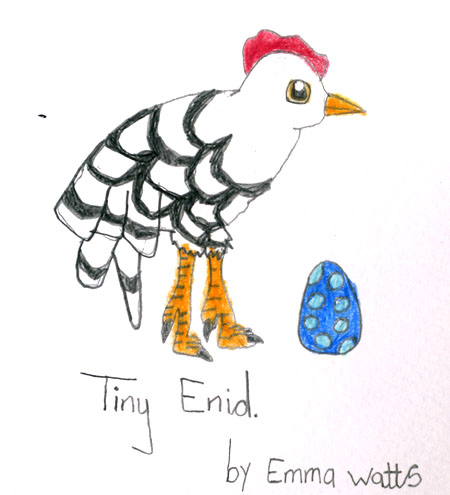
Over at Mustard Plaster, Miss Hathorn has posted a portrait of her hen, sensibly named after everybody’s favourite plucky infant adventuress. In a less vapid world, Emma Watts would be a shoo-in for the Turner Prize rather than one of those Hoxton chancers.
Â
Â
Â
Â
Â
Â
Â
Â
Â
Â
Â
Â
Â
Â
Â
Â
Â
Â
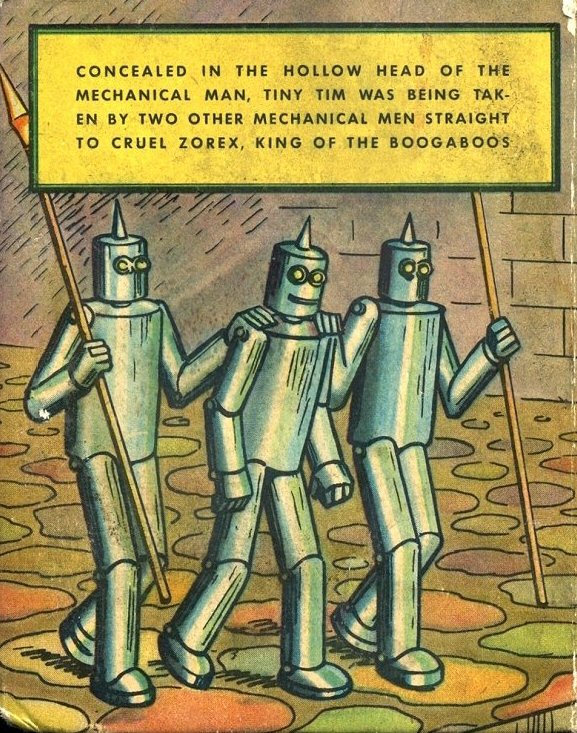
One thing is abundantly clear. I am going to have to write a story to which this picture can serve as an illustration. I expect that in my tale Tiny Tim will be cast aside and replaced by Tiny Enid. The plucky heroine has not, to date, found herself concealed inside the hollow head of a mechanical man, so it is about time she did.
You can see the original source of the picture at Monster Brains.
In the comments on the piece entitled It Pays To Increase Your Word Power, reader Fitzmaurice Trenery makes mention of fruiterer’s adhesive. This reminded me of a little-known story that is told about Tiny Enid, in which the plucky club-footed tot devised a method of placating wolves through the agency of fruit-based gas sprays. Yes, yes, I know that a gas spray is a different order of thing to a fruiterer’s adhesive, but given that most fruiterer’s gums and pastes are made from mashed bananas and the pulp of tangerines, and that Tiny Enid’s gas spray was formed, at least in part, by a gas derived from the pulp of bananas and mashed tangerines, I think I am on pretty safe ground in forging the link.
The weird woods of Woohoodiwoodiwoo, near where Tiny Enid spent some time in a boarding house, were infested with packs of fierce and dangerous wolves, packs which had savaged any number of innocent woods-hiking types who blundered foolishly into the weird woods of a weekend. The heroic infant was not herself a hiking enthusiast, but she had a curious sentimental affection for hikers, with their thick woolly socks and social ineptitude. Alarmed by reports of wolf attacks, she took it into her head to do something about them. The attacks, that is, not the reports of the attacks. She sighed and left it to someone else to take on the task of correcting the slapdash grammar, misspellings, and vile prose in which the reports written by the cub reporter on The Daily Wolf Attacks In The Woods Clarion were couched.
Tiny Enid’s first impulse was to slaughter the wolves, one by one, in hand-to-paw combat, or with pebbles and a catapult, or with her trusty blunderbuss. She had got as far as driving towards the weird woods in her souped-up jalopy, flying a banner emblazoned with the words “Death To The Wolves In The Woods!” daubed in blood, when she had to brake sharply and slew off bumpety-bumpety-bump into a field to answer an urgent message on her metal tapping machine. Tiny Enid was an independent sort of girl, but she had a mysterious mentor whose advice she often took. It was this mentor who suggested to her that rather than killing the wolf population she instead seek a method of placating them. “I have no particular love for wolves,” came the tapped-out message, “But we must be ever mindful of biodiversity, Tiny Enid. The earth can support both wolves and hikers, just as it supports both fruit flies and fruit.” The diminutive adventuress was not wholly convinced by this analogy, but on this occasion she deferred to her mysterious mentor, possibly because she had been reading up on the Gaia theories of James Lovelock, drawn to them by her interest in the primordial and chthonic deities of the Ancient Greek pantheon. Never forget that Tiny Enid was a girl of broad education, even if the only book she ever learned by heart was Atlas Shrugged by the postage stamp collector Ayn Rand.
Faulty as the fruit and fruit fly analogy may have been, it obviously set Tiny Enid to thinking how fruit might help her placate the wolves of the weird woods. She turned her jalopy round and sped back to town to consult some encyclopaedias in the library. Unfortunately, thick-headed Andy Burnham had got there before her, and the reference section had been turned into a chill-out zone for feral teenagers. There was not an encyclopaedia to be seen, just games consoles and reconstituted patties of meat in buns. Tiny Enid felled a handful of youths with pebbles fired from her catapult before heading off to the laboratory of her pal Professor Fang, a man who knew a thing or two about fruit and wolves, as he knew about everything else in the universe, everything, that is, except for hiking and thick woolly socks, for he was an indoors type.
“I want two things from you, Professor Fang,” announced Tiny Enid in her shrill shouty way, “First, a method of placating wolves with fruit, and second, a way of reprogramming the spongiform grey blob that passes for the brain of the Secretary of State for Culture, Media and Sport. Due to his thick-headed ways I have had to use my stock of pebbles just now, and will have to waste precious time collecting further catapult ammo. Who knows how many hikers will be torn apart by wolves in the weird woods of Woohoodiwoodiwoo while I am scrabbling around at the allotments replenishing my pebble supply?”
“Give me fifteen minutes,” replied Professor Fang.
So it was that, in the time it would take to read a chapter of Atlas Shrugged, the madcap boffin devised both the spray of banana pulp and mashed tangerine-based gas with which Tiny Enid was able to placate the wolves, and a similar gas, derived from tomatoes and conference pears which, when injected into Andy Burnham’s head through his ears, would allow his brainpans to work properly.
History – and hikers – tell us that Tiny Enid succeeded in becalming the wolves and making them less savage. After the heroic club-footed infant had clumped from one end of the weird woods to the other spraying her gas, not a single hiker was ever attacked again. The Daily Wolf Attacks In The Woods Clarion, having no news to report, was forced to close down, and its cub reporter became a bitter enemy of Tiny Enid, feeding spurious stories about her to The Independent On Sunday and other downmarket rags. Not that the tiny one cared, for she was forever after the champion of beardy men and batty women with maps in protective cellophane pochettes on lanyards, safe at last to tramp through the weird woods of Woohoodiwoodiwoo.
As for the terrible tale of Andy Burnham’s brain, that is unsuitable for family reading, and will have to wait for another, more ghastly, time.
The always intriguing Strange Maps has a very useful map of Liechtenstein showing the eleven enclaves (some of which are possibly exclaves) into which that tiny principality is divided. They are (in alphabetical order) Balzers, Eschen, Gamprin, Mauren, Planken, Ruggell, Schaan, Schellenberg, Triesen, Triesenberg, and Vaduz.
Tiny Enid is thought to have spent some time dwelling in a chalet in Planken, though no plaque or inscribed stone exists to mark what might, after all, be just a rumour put about those seeking to muddy the waters of the plucky tot’s biography, if a biography can be said to have waters. I shall have further words to say about those who sow confusion in the field of Tiny Enid life studies shortly, and they will be stern words, sulphurous ones, declaimed from a platform, a platform I hope to erect in Planken itself, or failing that, in Schaan or Balzers. The platform will be made from expensive wood, as you would expect, but the carpenters will be cheap, if I do my homework, which involves consulting a directory of Liechtensteinian carpenters and other woodworkers and ranking them according to price. Such an activity can becalm the most anguished of souls.
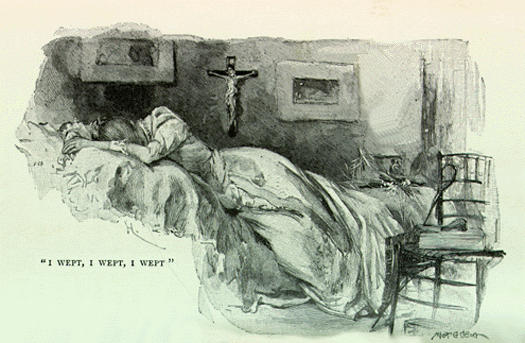
Like Kaspar Hauser, she was an enigma. Like Petra Von Kant, she wept bitter tears. And like Woodcarver Steiner, she knew great ecstasy. But was it a religious ecstasy, or was it, as for Woodcarver Steiner, related to ski-jumping at championship level?
Had she been so inclined, there is no doubt that Tiny Enid could have been a top skier in spite of her club foot, for we know that she never allowed that infirmity to dissuade her from the most remarkable exploits. Hang-gliding, hot air ballooning, pole-vaulting and daring undersea rescues were among her many accomplishments, and she was only narrowly pipped to the post in a vinkensport contest when her finch, Edgar, became rattled and chirped susk-e-wiat instead of susk-e-wiet in the final minutes. Yet we have no evidence that Tiny Enid ever strapped on a pair of skis, nor dwelt in an area of snow fallen on sloping ground.
Equally, however, if hers was a religious ecstasy, we are hard put to identify to what brand of supernatural belief it could be ascribed. Those who knew Tiny Enid crinkle in glee as they recall that, like Benjamin Péret, she spat at Catholic priests, so I think we can rule out the Ratzingeristas, as we can confidently dismiss any connection to Aztec fundamentalism, given Tiny Enid’s reported remarks on Temaxcaltechi, the goddess of sweatbaths, whom she described as “far too sweaty”. This is not the place to examine Tiny Enid’s somewhat unseemly preoccupation with both human and divine sweat, for we must keep on track.
That track is the one we hope would lead us to know the source of Tiny Enid’s great ecstasy. With Woodcarver Steiner we know where we stand, as we do with Saint Teresa of
Trawling through the various biographical documents which survive, I have found no indication that Tiny Enid ever professed any religious impulses whatsoever, nor, for that matter, any more broadly spiritual leanings. Indeed, all accounts agree that she was a severely practical type of heroic infant, never more essentially herself than when solving very concrete problems, usually involving the rescue of persons imperilled. One thinks, for example, of Tiny Enid abseiling down a crevasse to deliver a life-saving polythene bag of nutritious bread pudding to the half-starved, half-frozen polar explorer Sir Blinky Cheeselip, or digging a tunnel under the Vindervandersee to reach a trio of extras from a Werner Herzog film trapped in a subterranean pool rife with blind albino aquatic tentacled beings each with thousands of razor sharp fangs and unassuageable appetites. One pictures Tiny Enid kicking a git in the head with her big black boot.
Perhaps, we must ask, it was her reveries of such deeds which sent her into her great ecstasies? We ask, but for the time being we cannot answer “yes” with any great conviction, not until much further work has been done to disentangle the hugely complicated legacy Tiny Enid left in her heroic, infantile wake.
OutaSpaceman dropped me a line to point out that I failed to observe the feast day of St Mungo last Monday, 14th January. Remiss of me, I know. To make up for such an inexplicable oversight, let me draw your attention to St Prisca, whose feast day is today.
St Prisca was a child martyr, and you can read all about her in The Book Of Saints And Friendly Beasts by Abbie Farwell Brown. You will learn how, “Small and defenceless though she was, she did not fear to tell everyone what she believed and Whose Cross she followed. So she soon became known as a firm little Christian maiden.” When you have read this stirring tale, and wept, yet felt strangely uplifted, I recommend some of the other stories you will find there, such as Saint Keneth [sic] Of The Gulls, Saint Launomar’s Cow, Saint Fronto’s Camels, and Saint Werburgh And Her Goose. That should be quite enough saints to keep you occupied and out of mischief.
NOTE : It strikes me that St Prisca comes across as a Christian version of heroic infant Tiny Enid, many of whose exploits have been recorded here. I am not aware to what, if any, religious persuasion Tiny Enid adhered, but I shall do some research and let readers know in due course.
Blodgett went to the library one day and borrowed Heart Of Darkness by Joseph Conrad. He took it home, read it at one sitting, and was never the same man again. He identified so closely with the character of Mister Kurtz that he hit upon the conviction that he actually was Kurtz. Reincarnation is a foolish idea at the best of times, and to imagine oneself to be a fictional maniac reborn is doubly foolish, but that was Blodgett for you.
Over the following day he put his affairs in order, having resolved to set out for his very own heart of darkness. Lacking the means to travel to somewhere remote, he trudged across the cow-strewn fields until he reached the
At first, his diktats were surprisingly sensible, relating as they did to such matters as animal husbandry, crop rotation, rural post office opening hours, and other mundanities of countryside subsistence. How Blodgett knew about these things in the first place is an ineffable mystery. One is tempted to think he had a concealed laptop and was sneakily looking things up on the wikipeasantry website, but later, when it was all over, he was injected with a newfangled truth serum and passed muster when denying such subterfuge. Perhaps, as he claimed, it was simply that he was imbued with the spirit of his fictional alter ego, a multitalented polymath, rather like the late Anthony Burgess. Incidentally, I have always wondered if it is true that, when casting Apocalypse Now, his film adaptation of Conrad’s novella, Francis Ford Coppola’s first choice to play Kurtz was Burgess rather than Marlon Brando.
Anyway, as is the way with these things, Blodgett’s initial common sense soon gave way to demented megalomania, and his diktats became ever more ludicrous. He took to commanding not merely the sulking peasants of Much Snuffling but the sun and the moon and the planets. Celestial bodies tend not to adjust themselves in obedience to the ravings of a wild-eyed loon sat in the corner of the pub, and their lofty indifference first baffled Blodgett and then enraged him. So thunderous did his mood become that the Much Snufflingites held a secret meeting one night when Blodgett had taken to the hills to shout at the sky. With great presence of mind, they sent for heroic infant Tiny Enid, who arrived the very next day and booted Blodgett all the way back across the cow-strewn fields to his hovel.
He spent a day muttering to himself, and then returned Heart Of Darkness to the library, dutifully paid his fine for it being overdue, and chose another book. Next week, you shall learn what a pickle he got himself into after reading The Scarlet Letter by Nathaniel Hawthorne, and convincing himself he was the reincarnation, not of Mister Kurtz, but of Hester Prynne.
CLUBFOOTED TOT WINS HEROISM CUP. This was the headline on the front page of the Daily Brouhaha that first brought Tiny Enid to national attention. Until then, her heroic exploits were known only to a few. Her intervention in the case of the gormless nipper changed all that, at least for a while, until a fad or frippery came along to divert the fickle public. Yet some of us have not forgotten the heroic infant, and it is important that a new generation be reminded of her deeds.
The gormless nipper was roughly the same age as Tiny Enid, and of roughly the same diminutive stature, but otherwise the pair of them might have inhabited different planets. Where Tiny Enid was heroic, the nipper was gormless. Where Tiny Enid showed valour, gusto, and dash, the nipper was gormless, gormless, gormless.
The nipper was raised in an orphanage not unlike Pang Hill Orphanage. It was a monstrous black brick building crumbling upon a hillside. One winter’s day, the gormless nipper was leaning out of a window gazing gormlessly at the sky when he fell, landing in a gormless heap in the snow. Instead of trudging back to the huge iron door of the orphanage and rapping his tiny fist upon it until the kindly matron let him back in, the gormless nipper wandered off, away from his grim black brick home, ever further away, until he was quite lost. Thus began a series of accidents and misadventures which befell him due to his gormlessness. Stopping to rest at a level crossing, his cravat was singed by sparks from a passing locomotive. When he made to untie the cravat to look more closely at the singeing, he half-strangled himself and lost consciousness. Swooning, he fell forward so that the very top of his head almost touched the railway track, and when a second locomotive thundered past seconds later he received an inadvertent haircut, his locks torn out by the screeching metal train wheels. Had he had a mirror when he awoke from his swoon, the gormless nipper would have seen that he now had the appearance of a tonsured friar. He roamed onwards, crossing the tracks, and fell into a pond. Minuscule aquatic beings within the pond attached themselves to his skin and burrowed through to his innards, where they fed upon his tissue and squirted out pond-venom. They were microscopic beings (actual size), so the gormless nipper was unaware of their parasitic sucking and squirting, and the amounts of pond-venom were so infinitesimally small that even the most advanced scientific apparatus would be unable to detect them. Nevertheless he began to feel off colour and when, eventually, the venom reached his brain it had the effect of increasing, rather than alleviating, his gormlessness.
The nipper slept that night in a byre, surrounded by cows. Discovered at dawn by a florid-faced farmer, he was set to work pulling a plough through a field. The winter sun blazed on his tonsure and turned the snow to slush, and by the time he was done ploughing, the nipper’s socks were soaking wet. He took them off and hung them up to dry on what he thought was a washing line. Alas, it was an electricity cable running from the farmer’s generator to a new-fangled power spade, and the gormless nipper was jolted by a shock of sufficient voltage to make him queasy. So when, shortly afterwards, the farmer fed him a bowl of soup, he vomited it up all over the freshly laundered farmyard kitchen tablecloth, an heirloom embroidered with unbelievable delicacy by the farmer’s great great grandmother. Understandably furious, the farmer kicked the gormless nipper all the way down the lane into the village square at Scroonhoonpooge and abandoned him there.
Dazed and sore, still queasy, and with the pond-venom coursing through his vitals, the gormless nipper slumped against a plinth. The village beadle found him there, tonsured and sockless and with sick on his sleeves, and accused him of defiling the statue of frizzy-haired minstrel Leo Sayer atop the plinth, which was the pride of the village. Thrown into a dungeon, the nipper slept fitfully that night in the company of mice and beetles.
The next morning, the beadle handed the gormless nipper over to a brute to whom he would be apprenticed for the next six months. Day in, day out, the brute sent the nipper to the bottom of the sea in his bathyscaphe, from where he had to plunge into deep sea trenches and collect bioluminescent organisms. The goggles of his diving suit did not fit snugly, and the gormless nipper gradually began to lose his sight. When he was almost blind, the brute rowed him out to sea and left him marooned on a whelk-encrusted rock.
And there he may have perished were it not for Tiny Enid. One day, eager to do a heroic deed, she sailed aloft in her hot air balloon and spotted the gormless nipper weakly trying to prise the very last whelk from the rock. Rightly judging that he was far too puny and famished to hoist himself up any rope she might dangle down to him, Tiny Enid set her burners roaring and ascended high enough to snare a cumulet. Tying a quickly-scribbled message to the bird’s leg, she propelled it in the direction of the Air Sea Rescue Station at St Bibblybibdib, then descended again until she was in shouting distance of the gormless nipper.
“Fear not, nipper!” she cried, “I am Tiny Enid and I have alerted the Air Sea Rescue Station at St Bibblybibdib to your sorry plight by attaching a message to the leg of a cumulet. The bird is flying its little heart out even as we speak, and soon a lovely big lifeboat will scud across the waves to rescue you. Preserve your energy, and stop trying to prise that last whelk from the rock, for soon you will be sitting at my kitchen table wolfing down a slap-up hot dinner of non-seafood items!”
And so it was that, nine months to the day since he had fallen from the orphanage window into the snow, the gormless nipper returned to his grim black brick home. He was driven there by Tiny Enid herself, in a hired charabanc, on the day after she was awarded a tin cup for heroism. The gormless nipper had managed not to be sick all over Tiny Enid’s tablecloth, and a few eye drops from her mysterious cabinet had restored his sight. The hair had grown back where it had been ripped out by the locomotive, and his heroic rescuer selflessly gave him a pair of her own socks to replace the ones still hanging neglected from the farmer’s electricity cable. Had Tiny Enid known that the nipper was riddled with microscopic aquatic parasites squirting pond-venom, no doubt she would have found a way of exterminating them. She was that kind of girl.
The other day I had some harsh words to say about the out of print pamphleteer Dobson’s song-writing skills. “No one with any sense has ever listened to a Dobson song more than once”, I wrote. Well, it seems I was mistaken. I was rummaging in a satchel that I found abandoned on a canal towpath, and I came upon indisputable evidence that at least one sensible person admired a Dobson song so much that they recorded a cover version of it. The song in question is one of the pamphleteer’s settings from the Book of Isaiah.
Hooting Yard readers are a wise bunch, and I would not be surprised to be deluged with letters accusing me of making up the whole satchel-rummaging incident in some foolhardy attempt to chivvy up Dobson’s reputation. I therefore arranged for a local snapper to take a snapshot of what I found, as proof.
Thanks, by the way, to boynton.
Yesterday I listened, belatedly, to a Little Atoms interview with Jonathan Meades. (It’s available for download here – the second one, dated
The entry devotes a paragraph to de André’s kidnapping by Sardinian bandits in 1979, which is interesting, but I thought I’d draw your attention to two other things, mentioned in passing, that particularly intrigued me.
De André’s first wife was named Puny. This is a superbly Hooting Yardish name, isn’t it? I do not think it will be too long before a character named Puny turns up in a piece of prose here, perhaps one that features heroic infant Tiny Enid. I recall that somewhere or other I refer to a book or film entitled I Was Puny Vercingetorix, and though puny there was intended as an adjective rather than as a first name, I may have to revisit that in the light of my new knowledge.
The other thing that made me slap my forehead with glee was the title of de André’s second album – or rather, the contrast between it and the titles between which it was bracketed. (Forgive those two ‘between’s, I can’t think offhand of a more felicitous way of putting it.) The first album was called Volume One, and the third was dubbed Volume Three. Yet for some extraordinary reason, the title of what a lesser artist would have called Volume Two was instead Tutti morimmo a stento, or We All Died Agonizingly.
That’s the thing about Jonathan Meades, he provides you with new and unexpected avenues to explore, even when he’s just picking a piece of music.
The tale is told of the volunteer brevet cadet who, in spite of his shocking weediness, was sent on a dangerous mission. He had to travel, alone, through a hostile environment – think belching volcanic gases, creeping tendrils and suckers, fierce slavering beasts with razor sharp fangs, turbulent rivers, turbulent skies, turbulent storms.
The field station commander was a man of unparalleled experience in this hostile environment, and he was confident that the brevet cadet would be emboldened by wearing a pith helmet, and that his whimpers would soon be a thing of the past. It pained him, then, when, six days later, he received a message by pneumatic funnel from the next field station along the line that the puny volunteer had tottered into the hut sobbing and wailing and quivering and generally lacking in resolution, bravery, and grit. The commander of the second field station bid him lie in a hammock and cranked up a gramophone player, hoping to increase his gusto by having the brevet cadet listen to stirring tunes played by the finest brass bands and dance orchestras. One recording in particular that was likely to do the trick was Enrico Pepinger’s version of “Hurrah Boys, Let Us March With Sprightly Tread Through Wild Lands Where We Fear Not The Buffets Of Those Who Would Cause Us Harm”.
By the time he reached the third field station, nine days later, he was feverish, shivering and shaking uncontrollably, half blind with terror, and calling out weakly for his Mama. He slumped against the door of the field station hut and begged for death to end his misery. And then, out of the hut came, not Death, but heroic adventuress Tiny Enid, who had flown in on her biplane just minutes before. She plucked the weedy cadet up and shoved him into the hut, where she poured four canteens of piping hot Batavian Twilight tea down his gob, wrenched off his standard issue dangerous mission footwear, and presented him with a pair of gumboots.
“Listen, puny cadet,” she said, not unkindly, “You have volunteered for this dangerous mission, and you will succeed! By wearing these gumboots, you will be emboldened, and one day you will return to HQ as a hero, a credit to your trooplet. Off you go!”