Archive for the 'Old Farmer Frack' Category

Eggs, Stick

It is quite some time since I have heard from Dr Ruth Pastry, but at last she has broken her silence. Here is her letter:

Dear Mr Key : Last week I read your postage Poultry Yards Of The Grand Archdukes and, though I was not impressed, I could not help but be intrigued by your reference to a breakfast recipe which involves, and I quote, “more eggs than you can shake a stick at”. How many eggs is that?, I wondered. The only indication you give, and I quote again, is “a goodly number of eggs”. This is less than helpful. “A goodly number”, in and of itself, is not a measurable quantity. A writer with more concern for his or her readers would be precise in these matters, and tell us plainly how many eggs we would have to assemble before we were no longer able to shake a stick at them.

Because of your laxity, I was put in the position of having to find out for myself. I went for a walk in the woods and came back carrying a stout and sturdy stick. I think it was a branch from a hornbeam. It was a very shakeable stick, as I ascertained by shaking it experimentally a few times while still in the woods. Squirrels scattered as I shook it, and there was movement in shrubbery as if a small woodland creature had been startled. Had I had with me my net, I would have used it to entrap the creature, whatever it was, and then rained blows upon it with the stick until ’twere dead, and taken it home with me to boil for a snack, garnished perhaps with a tomato and some basil. As it was, I was netless, so I returned home with just the stick.

I then set to preparing my test area. You know, I think, how thorough I am. I shoved the kitchen table back against the kitchen wall, thus creating sufficient space for me to be able to shake the stick without risking damage to my many and various kitchen appurtenances. Next, I opened my refrigerator, and removed from it every single egg currently in my possession, placing them, in their carton, on my countertop. I was somewhat dismayed to note that I had only five eggs, from the carton’s original complement of six. My instinctive thought was that five was unlikely to be the “goodly number of eggs” you prescribed. However, instinct is one thing, and empirical evidence is another thing entirely. It was clear to me that the absolute minimum possible indicated by “a goodly number of eggs” was a simple plurality, in other words, two eggs.

Before continuing, I fetched from a cubby a fresh ledger, dozens of pages of creamy paper divided by faint blue lines into squares. In this, I would tabulate my results, using several different coloured pencils, which I duly sharpened with a pencil sharpener. I then removed two eggs from the carton and placed them on the table, taking care to position them in such a way that they would not roll off the tabletop and smash to squelchy ruin upon the floor linoleum. I had already made certain the tabletop was level, using a Van Der Hoddle Levelometer, a splendid device which I find far more effective than the common spirit level, and which uses no spirits whatsoever.

With the two eggs in place upon the table, as they would be were I to be embarking upon my breakfast preparation, I shook the stick at them. I suffered no hindrance, and could have gone on shaking the stick for hours upon end, had I been so minded. But I shook the stick only for long enough to become convinced beyond any shade of doubt that two was not the “goodly number of eggs” defined as “more eggs than I could shake a stick at”. I noted the results in the ledger, painstakingly, and then removed a third egg from the carton and placed it next to the original brace of eggs on the table, proceeding to shake the stick once again.

You will, I suppose, have worked out that soon enough I tried four, then five, eggs, with identical outcomes. Pleased as I was with the severe beauty of the tabulation of results in my ledger, I had now exhausted my supply of eggs. For a madcap moment, I considered propping a mirror upon the kitchen table, thus doubling the visible number of eggs, thinking by doing so I could somehow “trick” the stick. Two immediate objections to such tomfoolery rapidly presented themselves. First, the positioning of the mirror would be enormously complicated if I were to be able to present the appearance of the intermediate egg numbers, from six through nine. Second, the stick was just a stick, from a hornbeam, probably, and did not in itself have sense perception, visual or otherwise. The impossibility of shaking a stick at “a goodly number of eggs”, whatever that number might be, was, I felt sure, dependent not upon the stick itself, but on the quantity of eggs one was attempting to shake it at. And in turn, that surely meant they had to be real eggs, not mirror images nor any other eggs of illusion.

Now, I was reluctant to march off to my nearest egg shop to buy the extra eggs I would need. For one thing, I had no idea how many eggs that might be. Also, what was I going to do with them all when my experiment was done? One can only eat so many eggs before becoming disgusted at the prospect of yet another egg-based meal, and it would be a terrible sin, and a waste of money, to let them rot uneaten. I thought it unlikely that the proprietor of the egg shop would be willing to allow me to return any bought but unused eggs, for he is not the most amiable of shopkeepers. Indeed, more than once I had had blazing arguments with him, and not always on the subject of eggs.

Then I recalled that there had been recent tidings from the farmyard of Mad Old Farmer Frack. It was said that he was no longer devoting himself exclusively to his bellowing cows, but had installed a hen coop, with hens in it, on the farm. Where there’s hens there’s eggs, I said to myself, not wholly grammatically, but memorably. I wondered if it was an old country saying. I resolved to ask Old Farmer Frack if this were so, although the main business of the visit to him I now embarked upon, without delay, was to borrow from him as many eggs as possible.

“Hail to thee, Old Farmer Frack,” I cried, within the hour, leaning against his fence, “I was wondering if it would be possible for me to borrow from you as many eggs as possible? I will bring them back before nightfall.”

The mad old farmer was standing in the middle of one of his fields, looking mad and farmerly, doing something with a spade. When he heard me, he looked up, let fall the spade, and came bounding over to me at inhuman speed. His eyes were bloodshot and his hair was a tangle of filth.

“My eggs are not for borrowing,” he said, “Under any circumstances. But for an old friend like you, Dr Pastry, I might consider renting them out.”

And so we haggled. We had done so many times before, over the years. The thing is, I have advanced haggling skills, whereas Mad Old Farmer Frack is hopeless and inept in this area as in so many others. Within a few minutes, I had him agreeing to let me take away hundreds upon hundreds of eggs in return for a photocopy of my bus pass and a sprig o’ myrtle. Of course, I then had to scoot off to town to get the photocopy, and pop in to Myrtle Sprigs R Us® to get the sprig, but that was soon accomplished.

When I returned to the farm, Mad Old Farmer Frack was nowhere to be seen. I thought he might be herding his bellowing cows from field to field, pointlessly, and went a-roaming to see if I could spot him, and them. I found the cows, all of them, without their farmer, standing around in a distant field beyond a drainage ditch, in the rain. I trudged back through muck and puddles to the hen coop, and poked my head in for a look-see. Lots and lots of hens, but no farmer, and, more to the point, no eggs. A couple of the more savage hens made moves to attack me, but I remonstrated with them in a sort of screechy hensprache I picked up from a hen person I met on my travels, long ago, and they were immediately pacified, and not just pacified but put into comas, from which they will only awake when next it is time for them to lay an egg.

That done, I wandered aimlessly around the farm for a few hours before giving up and going home, cursing Mad Old Farmer Frack and throwing pebbles at crows in my annoyance. I unlatched the door of Pastry Cottage, and there, in my kitchen, was the mad old farmer himself, waving a stick at the kitchen table upon which teetered a gigantic pile of eggs. He looked around as I came in.

“Ah, there you are, doctor,” he said in his mad voice, “I was so interested in what you were telling me about your egg experiment during our haggling process, I thought I’d carry on where you left off while you were fetching the agreed rental. Speaking of which, do you have the photocopy of your bus pass and the sprig o’ myrtle?”

Nonplussed, I handed over the items without a word.

“So far I am up to a hundred and sixty-two eggs,” said Old Farmer Frack, “And still nothing is impeding me from shaking the stick at them.”

“Have you been tabulating the results in the ledger?” I asked, not unreasonably.

“Oh… I forgot to do that bit,” he said. At least he had the grace to look shamefaced.

“Then we must begin again, from six upwards,” I said, “Otherwise the experiment will not have been conducted with sufficient rigour.”

“Yes, yes, of course,” said the mad old farmer, and I was delighted to see that he immediately began to remove a hundred and fifty-six eggs from the table, one by one, with surprisingly dainty movements, placing them hither and thither about the kitchen wherever he was able to find space among the many and various kitchen appurtenances I mentioned earlier, only a few of which he had broken or dented when clumping about before suddenly remembering his daintiness upon my arrival home.

I have to say that tackling this as a two-person job has been a marked improvement. I can concentrate on the majestic sweeping penmanship of my ledger entries, while Mad Old Farmer Frack shakes the stick. As a farmer, he is able to shake a stick with much more conviction than I can muster, for of course he shakes a stick at something most days, whereas I only rarely do so. We are taking it in turns to move the eggs from their temporary storage places, one at a time, to join the eggs accumulated upon the table.

I am beginning to worry if the legs of my kitchen table will continue to support the ever-increasing weight of eggs, and, as I write, have sent Mad Old Farmer Frack off to fetch lengths of titanium cut to size, from Old Ma Purgative’s Cut To Size Titanium Reinforcement Rods Shoppe. I scribbled a note for him to take, explaining to Old Ma Purgative that the table is currently supporting six hundred and forty eggs, and asking that she supply titanium rods sturdy enough to support twice that number. I added, of course, the relevant measurements, of both my table legs and the approximate weight of eggs.

Fairly soon, however, we are going to run out of eggs. Between us, I am sure we will work out how to get more, by hire or theft or, as a last resort, cash purchase. Meanwhile, I am beginning to wonder just how many eggs we will have piled on my reinforced table before I pause, coloured pencil held steady over my ledger, and the time comes when Mad Old Farmer Frack raises the hornbeam stick, to shake it yet again, and finds – oh! sweet mystery of life, or rather of egg-numbers – that he is completely unable to do so. When that time comes, Mr Key, I will write to you again, requesting further details of your eggy breakfast recipe, which I have no doubt is both succulent and toothsome.

Yours waiting for Mad Old Farmer Frack to come crashing through the door,

Dr Ruth Pastry
Pancake Day

[This piece ought to have appeared on Tuesday. Mea culpa.]

Dobson adored Pancake Day. Every year, in the weeks leading up to Shrove Tuesday, he grew ever more hot-brained and excitable, gathering sacks of flour, carrying out repeated Orwellian egg counts, and begging Old Farmer Frack for churns of milk from the mad old rustic’s cow collection. Every year, too, he revised, polished, embroidered, and sometimes even rewrote from scratch his pamphlet Pancakes : Food Of The Gods? (out of print).

In the complete Dobson bibliography, this title appears both with and without that question mark, like Sidney and Beatrice Webb’s fatuous Soviet Communism : A New Civilization?, written in 1935 at the height of Stalin’s terror, which lost its question mark between its first and second editions. Why Dobson ever phrased his title as a query in the first place is unfathomable, for he was absolutely convinced that all divine beings subsisted on pancakes and nothing else. A glance at any sacred text or compendium of myths quickly disproves the pamphleteer’s theory, if we can call it that, though “delusional idée fixe” would express it better. Dobson spent a preposterous amount of time working his way through the foundational texts of all major religions, Tippexing out all mentions of foodstuffs and, as soon as the Tippex was dry, scribbling in the word “pancakes”. At one point he commissioned Rex Tint, the noted mezzotintist, to create a mezzotint showing the Greek gods atop Mount Olympus, stuffing their faces with pancakes. The work was never completed, or even begun, because Dobson wanted to pay the mezzotintist in eggs, flour, and milk, and Rex Tint, famously, was a “cash only” mezzotintist.

It comes as something of a surprise to learn that in spite of his enthusiasm, Dobson was a hopeless pancake maker. He could never get the mixture quite right, and his tossing technique was laughable. He tried to divert attention from his pancake ineptitude through a combination of bluster, weeping, and pointing out of the window at an imaginary flock of chaffinches. Only late in his life did he face up to the truth, in the remarkable pamphlet My Pancake Ineptitude : A Heart-Rending Confession In Sixteen Bursts Of Hallucinatory Prose (out of print). In the sixteenth and final text, Dobson makes his most compelling case for the divine nature of this simple aliment, although the prose is so hallucinatory that not even the most diligent, pancake-focused reader can work out what in heaven’s name he is babbling on about.

ADDENDUM : A better, and more accurate title than Soviet Communism : A New Civilization would have been Soviet Communism : Enemy Of Orchards, as Michael Gilleland at Laudator Temporis Acti reminds us.

One Thousand

Today there is cause for celebration. No, not the Muggletonian Great Holiday, that was last week. The reason for unbridled cheer is that what you are reading is the one thousandth postage at Hooting Yard since the site was rejigged at the beginning of 2007. (I cannot recall precisely how many postages appeared in the old format, to be found in the 2003-2006 Archive, but if memory serves it is something in the region of 950.) A milestone to be celebrated, then – but how?

Ideally, you lot would cancel all other engagements, put your feet up, and spend the rest of the day rereading all one thousand postages, in chronological order, making notes in your jotter, pausing occasionally to stare out of the window as you mull over a particularly arresting item, and generally wallowing in the sheer Hooting Yardiness of it all. Always remember that a day devoted to Mr Key is never a wasted day. However, I am sensible enough to realise that most of you will have other things calling on your attention, such as feeding the hamster, waiting at the bus stop, smoking, genuflecting, pootling about, milking the cows, rummaging in the attic, taking your pills, repairing the fence down by the drainage ditch, tallying up the entries in your ledger, doing the dishes, spreading jam on bread, clutching at straws, embarking on a perilous journey downstream by kayak, grovelling in filth, putting the spuds on, intoning spells against the pestilence, mucking about, boiling your shirts, describing an arc parallel to the surface, dusting the mantelpiece, rekindling that lost love, chopping celery, going for gold, doing the odd bit of trepanning, squeezing out sponges, cutting up rough, vomiting, preening, polishing your shoon, checking the gutters, making hay while the sun shines, piling Ossa upon Pelion, folding your towels, voting with your feet, remembering a childhood idyll, splitting an atom, clocking in, lurking in the shrubbery, gathering your wits, burning an effigy, being Ringo Starr, toiling to no purpose, making whoopee, burgling the Watergate building, casting the runes, mesmerising a duck, emptying the bins, licking some stamps, darning a hole in your pippy bag, crunching numbers, thwacking a bluebottle, going rogue, distributing alms to paupers, looking shifty, holding out a glimmer of hope, pole-vaulting, caterwauling, playing pin-the-paper-to-the-cardboard, rinsing lettuce, closing the barn door, glorying in crime, sticking to the point, feeling off colour, pondering the ineffable, gargling, straining, wheedling, pining, flailing, and lying crumpled and woebegone and exhausted and hot-in-the-brain. You may have to do all of these or none, but in either case the chances are that you will be unable to devote your every waking hour to Hooting Yard, even though you yearn to do so. We shall have to come up with some other form of celebration.

It is at times like these a person’s thoughts turn to cake. It will have to be an enormous cake, to fit a thousand candles on to it. Think of all that burning wax!

I shall leave you with that thought, and press on. One could, of course, throw a party. Invite a thousand guests, and have each of them commit to memory, for party-piece recital, the text – or, as bespectacled postmodernist Jean-Pierre Obfusc would say, the discourse – of one Hooting Yard postage (including this one). The drawback to this otherwise fantastic scheme is that some postages run to thousands of words, whereas some, very occasionally, have been wholly pictorial, other than the title. Allocating all one thousand to the satisfaction of every single guest is a task fraught with difficulty, and is unlikely to be achieved without conflict and, indeed, fist-fights. Now, incidents of physical violence are not unknown among the readership. Even the surprisingly numerous Hooting Yard devotees of the Mennonite faith engage in punch-ups from time to time. Don’t even go there, as the airheads say. Taken all in all, I am not sure the party is such a good idea. Anyway, where would you fit so many people? They would not all fit into your chalet or hovel or well-appointed yet curiously pokey high-rise urban living pod, and rental fees for barns and disused aeroplane hangars have gone though the roof, according to what I have been reading in So You Want To Rent A Barn Or A Disused Aeroplane Hangar, Do You, Chum? magazine. (It’s interesting to note, by the way, that the late Harold Pinter was on the editorial advisory board of this threatening, sinister publication.)

Cake, burning wax, and party all proving prohibitive, what are we to do? Well, in extremis, one can always turn to Mrs Gubbins for some outré ideas. For once in her life, the octogenarian crone is not helping police with their inquiries, in spite of that dodgy business with the pile of mysteriously bleached bones and the trained vulture, and she is to be found snugly ensconced in an attic room at Haemoglobin Towers, furiously unravelling tea-cosies. Where once she did knit, now she unravels. By heck, there will be a glut in the used wool market by the time she is done! It is possible this is part of yet another criminal scheme, but if so it is one that is far too complicated for my puny and innocent brain. Best to ask no questions, and leave La Gubbins to her unravelling. I popped my head in to her sanctum, though, just to ask if she had any bright ideas for a Hooting Yard Thousandth Postage celebration. She looked up, fixed me with that unnerving gaze, like a blind person looking at a ghost, and pronounced the single word “Nobby”. Then she went back to her unravelling.

It was difficult to know what to make of this. The only Nobby that sprang to mind was Nobby Stiles, the popular Manchester United and England midfielder of the 1960s. His joyous capering on the pitch after England hoisted the Jules Rimet trophy in 1966 had captured the imagination of the press in those more seemly times, so perhaps that was what Mrs Gubbins was recommending – joyous capering on a field of grass. Or was she suggesting that I should enlist Nobby Stiles to help with planning a celebration? It seemed unlikely, though not of course impossible, that the retired footballer was a Hooting Yard fan, but even if he was, I did not know him, had never even collected his autograph when I was a tot, and had no idea how to get in touch with him. I entertained the thought that perhaps the crone had said “knobby”, with a K, meaning that which is characterised by having knobs, or the quality of knobbiness, such as, for example, a gnarled tree-trunk, or the backs of certain kinds of toad, but that seemed even more unfathomable. La Gubbins being the kind of woman she is, it is likely that her pronouncement was a sweeping one, containing all possible meanings of “(k)nobby”, with and without a K, plus additional meanings thus far unrevealed to the common timber of humanity. But I am afraid I had to dismiss, as wildly impractical, the idea of getting Nobby Stiles, and perhaps some other lesser-known Nobbys, to assist me in arranging a celebratory caper, of people and toads, round and round a tree in a field, much as it was appealing.

It was back to square one, and as we all know, deep in our hearts, the question always to be asked at square one is “What would Dobson do?” The beauty of the question is that if we are able to arrive at a half-way sensible answer, we know the guidance given will be infallible. Working out a valid Dobsonian response, however, is to blunder along a path strewn with nettles and serpents, unless of course one is satisfied with the generic answer “Write a pamphlet!”, which is, admittedly, correct ninety-nine times out of a hundred. Even in the present case, I can think of few methods of celebration more apposite than that every one of my readers should sit down at their nearest escritoire and pen a pamphlet. But think of the logistics. Someone would have to collate all the screeds, typeset them, print them, and distribute them to an uncaring world. I try my best to retain an attitude of breezy optimism, but I cannot see it happening. And I have not seen any vans driving past recently announcing, from the lettering on their sides, that they are in the business of Pamphleteering Solutions.

But “Write a pamphlet!” is not, invariably, the answer to the question “What would Dobson do?” Very, very occasionally, by deep analysis of the question, exercising the brainpans to their fullest extent and beyond, a different answer is revealed. To find out what this is we need to have an encyclopaedic knowledge of the complete Dobson canon, and to have pieced together as much biographical information on the out of print pamphleteer as we can, not excluding rumour, hearsay, tavern mutterings, and wild surmise. That is why I put the question to Aloysius Nestingbird, who knows more about Dobson than anyone else alive. As it happens, Nestingbird is only barely alive, following a calamitous bobsleigh accident. Quite what a frail ninety-two-year-old was doing plunging down the Caspar Badrutt Memorial Perilous Ice Declivity at the Pointy Town Antarcticorama is a question for the bigwigs at the Fédération Internationale de Bobsleigh et de Tobogganing, who I understand have already empanelled a Board of Geriatric Investigation to be headed by the fiercely independent, because ignorant of bobsleigh matters in general, Ant, or it might be Dec, the taller of the pair, the one with the glassy eyes of death.

Anyway, I bluffed my way into the clinic where Nestingbird languishes, using the techniques prescribed by Blötzmann in his Methods Of Dissimulation To Be Employed When Entering Restricted Medical Facilities (Second Series), an invaluable work which I always carry with me, just in case. Nestingbird was almost invisible beneath a panoply of tubes and wires and monitors and bleepers and what have you, but I ripped them out of my way and put my mouth to his still-bloody, gored ear, and put to him, in a dulcet whisper, the question. I want to arrange a celebration of the thousandth Hooting Yard postage. What would Dobson do? Nestingbird groaned, and some sort of despicable fluid bubbled out between his bloody lips, but he managed to tell me the answer, albeit in a croak so weak I barely heard it. But hear it I did. He said “Nobby”.

Returning home via the funicular railway, I racked my brains to see if I could wring any sense from this. Put in my position, it appeared, Dobson would “do Nobby”, or, I suppose, “do a Nobby”, as if that made any difference. Neither was a phrase I had ever heard before, and nor had any of my fellow-passengers, whom I badgered about it, growing, I am ashamed to say, rather hysterical, to the point where I was bundled off the train as soon as it reached the base station and taken round the corner, past snow-covered shrubbery, and handed over to Detective Captain Cargpan and his toughs. It is lucky for me that Cargpan is a fanatical devotee of Hooting Yard, otherwise I feel certain I would have ended up back in the clinic, and in a much worse state than Aloysius Nestingbird. Instead, the doughty copper let me off with a mussing of my tremendous bouffant. He didn’t know what “doing Nobby” was, either.

I had the sinking feeling that if I sought advice from anybody else, from born-again beatnik poet Dennis Beerpint, for example, or from Old Farmer Frack, I would get the same response. When I eventually arrived home, I made a cup of tea and heated a couple of smokers’ poptarts. Perhaps the celebration would have to wait upon the two-thousandth postage. Or perhaps I should be grateful for my simple snack. I sat down at the table, slurped the tea and shovelled down the bitter poptarts. Was this, after all, “doing Nobby”?

Wilf

Dear Frank, writes Tim Thurn, who has taken to calling himself Tim Thurn Of That Ilk, I assume in a desperate attempt to lend himself some gravitas, I was intrigued to read in your account of the Old Farmer Frack Memorial Essay Contest that the judges would include Wilf Self, Wilf Amis, and Wilfette Winterson. I have never heard of any of these people, despite being incredibly well-informed in all manner of subjects. Indeed, so huge is the amount of information stored within my brainpans that I have been compared, by idiots, to Stephen Fry, and by people with a modicum of sense to Roger Bacon (c.1219-1294), “Doctor Mirabilis”, the man who, it was claimed, had read everything.

Not wishing to doubt your word, I ran the names past my uncle, whose name also happens to be Wilf. He looked at me witheringly and, with barely a pause, accused you of having invented your Wilfs, and Wilfette, out of whole cloth. “These people do not exist,” were his exact words, and I believe him, for he has made a point, during his long life, of keeping tabs on all the Wilfs and Wilfettes who have ever existed. Some may think it a foolish hobby, and it probably is, but that’s my Uncle Wilf for you.

Anyway, his pronouncement set me thinking. Why, I asked myself, would Key go to the trouble of making up a couple of Wilfs and a Wilfette when he must have known that he would be exposed as a fraudster and scoundrel as soon as anyone took the trouble to check? I must admit that for quite some time I was stumped. I just sat there, chewing the end of a pencil, risking lead poisoning, beflummoxed. But soon enough it was time for Uncle Wilf’s daily outing, and I pushed him in his super whizzo wheelchair a few times around the pond, the pond next to the cement facsimile of the Old Tower of Lobenicht. You will recall that as the tower which Immanuel (not Wilf) Kant liked to look at through his window as he sat by the stove in circumstances of twilight and quiet reverie, not that he could be said properly to see it. Perhaps something of Kant’s cerebral magnificence imbued my own brain, in spite of the cement copy being a poor substitute for the real tower, for in a flash of insight I realised what it was you were up to.

My theory, which I am going to write up into an essay and have published in some obscure and unread academic journal, Wilf willing, is that you were dropping great clanging hints to your readers of the full names of some of those Hooting Yard characters whose first names we are never given. Wilf Dobson? Wilf Blodgett? Old Ma Wilfette Purgative? Old Farmer Wilf Frack himself? You need neither confirm nor deny that this is the case, Mr Key, for so sure am I of the stupendous accuracy of my flash of insight that I know, as well as I know the consistency of the drool dribbling down my Uncle Wilf’s chin, that I will be proved correct in the Harmanite court of public opinion, the only court that counts.

Yours ever, Tim Thurn Of That Ilk (and his Uncle Wilf, Of That Ilk)

My Favourite Pigsty

The title for this year’s Old Farmer Frack Memorial Essay has been announced. Entrants will be challenged to write fifty thousand words under the heading “My Favourite Pigsty”. This follows on from previous years where there was terrific interest in subjects such as “My Favourite Cow Byre”, “My Favourite Hen Coop”, and “Startle the poor sheep back! is the shipwrack then a harvest, does tempest carry the grain for thee?”

As usual, the rules of the contest are onerous. To commemorate Old Farmer Frack, essayists must use his own methods, which is to say that their fifty thousand words have to be either scraped on slates with a pointed stick, or done as Powerpoint presentations. Entrants have to assemble in a dilapidated barn in one of Old Farmer Frack’s fields before dawn on the designated date, and before putting stick to slate or fingertip to keyboard, each takes it in turn to drive the surviving cows down to the drainage ditch and back, bellowing all the while. The barn will be lit by a single Toc H lamp hanging from the rafters.

As soon as it starts to rain, entrants can begin their essays, and must continue writing indefatigably save for picnic breaks. These will take place at allotted picnicking times, under tarpaulins, in one of the puddle-riddled fields. Contestants may not discuss the progress, content, general thrust, or stylistic flourishes of their essays during the picnics, but confine themselves to talk of how great Old Farmer Frack was. It is permitted to suggest he was mad, but not too forcefully.

Judges for this year’s competition, who will also act as invigilators in the barn, include Wilf Self, Wilf Amis, Wilfette Winterson and Pebblehead, the bestselling paperbackist who has been commissioned to write the authorised biography of Old Farmer Frack and is a previous winner of the Memorial Essay prize. He won in the year the subject was “My Favourite Pebble”.

Entry is open to peasants, their friends and families. and those with whom they have been embroiled in rustic blood feuds reaching back for untold generations. The winner will be announced on the Muggletonian Little Holiday, the nineteenth of July.

This year’s prize is a muffin, and a pair of loaded pistols. 

The Branch Line Less Travelled

Every now and then I receive letters from readers asking me to give some account of the geography of Hooting Yard and its hinterland. I have a standard reply to such requests, which is to say that through diligent study of the writings you could draw a map yourself. It would involve very close reading, being on the alert for clues and pointers, but all the information any half-competent cartographer needs is present in the texts.

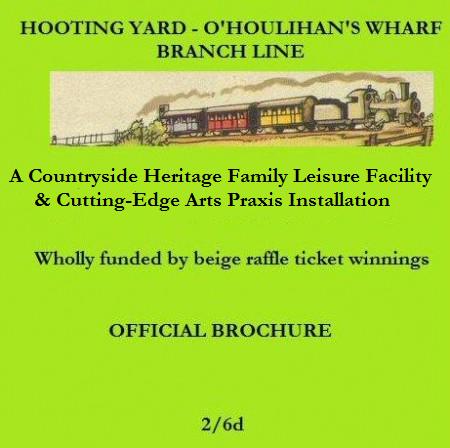
Today, I am going to make things a little easier for aspiring mappers by saying a few words about the train journey from Hooting Yard to that ill-starred fishing village O’Houlihan’s Wharf. Last week it would have been fairly pointless to do so, but the exciting news is that the branch line, long fallen into desuetude, is running again. Using the proceeds from a winning raffle ticket (number 666, beige) a team of volunteers has reopened the line as a cross between a “countryside heritage family leisure facility” and a “cutting-edge arts praxis installation”. I have taken those two phrases from their brochure, a shabby piece of work duplicated on a Gestetner machine, designed perhaps to look like one of Dobson’s out of print pamphlets. Someone has gone to the trouble of hand-colouring all the covers, though, which shows the fanatical devotion of these enthusiasts.

brochure-450x4481

I am not one of these nutters myself, but I know the journey as well as I know the first three books of Paradise Lost, so take my hand, encased in a butcher’s mitten, and I shall lead you along the way.

hy-station-sign

Our thrilling railway excursion begins, naturally enough, at Hooting Yard. What was once a gigantic terminus alive with hubbub is now a ruin which serves mostly as a roost for sparrows. However, the volunteers have recreated a very convincing facsimile of one of the original platforms, and it is from here that the decrepit steam engine creaks into gear.

civic-platform

It is, of course, the Civic Platform. It had been hoped to place a commemorative copy of the Central Lever at one end, but Hazel Blears put the kibosh on that with a series of threatening letters. Diminutive and bumptious she may be, but she – or her officials – can certainly write poisonous prose. The branch line volunteer who opens the post has been admitted to a clinic for neurasthenics and has taken to wandering the grounds in a daze, like Ronald Colman at the beginning of Random Harvest, without the military uniform, of course, but with the pencil moustache. Anyway, off we go!

blister-lane

The first stop, some five hours down the line on a good day, is Blister Lane. When I say “on a good day”, I mean on a day when the train does not sputter to a halt about twenty yards out of Hooting Yard because the track is blocked by cows. This can happen distressingly often, for the fields hereabouts are teeming with cows, thousands of cows, and though they may be content to stand still staring at nothing, the likelihood is that mad Old Farmer Frack will come bellowing and waving his stick and drive them back and forth across the railway line for his own, no doubt profound, purposes. He is not a farmer who can be bribed, so if he is doing his thing with the cows, the train just has to wait.

hoon

From Blister Lane we head on to Hoon. There are many who contend that Hoon is a place of myth, like Atlantis or Lemuria. Even if they are right – and remember, there is no definitive evidence either way – that is no reason Hoon cannot have its own railway station. The station itself shimmers, as if in mist, even on a clear day, and eerie sounds echo about its turrets and crenellations, for the station building is both turreted and crenellated, if blurry. It is not advisable to disembark from the train at Hoon.

horrible-cave

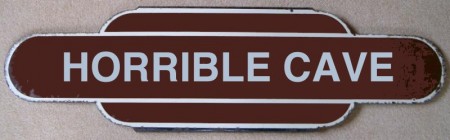
Nor is it a good idea to alight at the next stop, the Horrible Cave, unless you are an emboldened spelunker. Actually, there is a reasonable chance you may be so, for last time we did a readership survey it turned out that almost three-quarters of Hooting Yard readers have survived terrifying imperilment in caves, though not of course in the Horrible Cave itself. And it has to be said that the Horrible Cave is so horrible that it makes every other cave in any given subterranean system seem like a Prudence Foxglove Sunday School. The branch line volunteers refused to place any health and safety notices at the stations, even here, so you will have to keep your wits about you and use that unfashionable tool, common sense. But if you are a regular reader of Hooting Yard, you will of course have plenty of that.

macabre-village

And so we steam on, still creaking, to the Macabre Village. Please note that this is not the Macabre Yet Goofy Village you may have read about in the works of Jean-Claude Unanugu, nor the same writer’s Goofy But Macabre Village. Those are fictional. This is just a macabre village, with no goofiness to be found, however hard you might search. If you jump off the train here, try not to go too close to any of the buildings, and take a torch with you, the more powerful the better. In fact, take a torch and a bag of pebbles. You can throw the pebbles at anything macabre that looms out of the shadows intent upon attacking you.

the-ponds

Anybody with any sense will have stayed on the train, and be rewarded by arriving some hours later at The Ponds. This used to be a popular destination for picnicking parties, particularly the pond known as Stagnant Inky-Black Fathomless Spooky Pond, where generations of tinies cavorted and capered. Some of them even made it home alive.

pang-hill

From The Ponds it is a short hop to Pang Hill, where the famous Orphanage graveyard is well worth a visit. Take a cotton napkin to mop up your tears. Various mawkish pamphlets are available from the graveyard gift shop, including some insufferably dreary collections of verse by Dennis Beerpint, penned (as he would say) before his reinvention as a twenty-first century beatnik. On that point, it appears that our cherished poetaster has disavowed his earlier work. He issued some kind of manifesto the other day declaring that he intends to rewrite each and every one of his pre-beatnik poems in the beatnik style. Whether or not that is something to look forward to I am not sure. It might be a good idea to snap up as many of his twee verses as you can while you are at Pang Hill, if you can cease sobbing and do a Winslety gather.

pointy-town

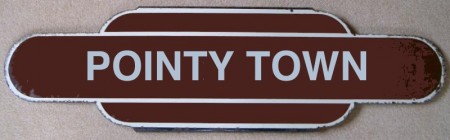
The next stop is Pointy Town. The station is, of course, magnificent, and very pointy. Indeed, it is thought to be the pointiest railway station on the planet. Before reopening the branch line, the volunteers made a special effort to eradicate any blunt bits on the station concourse, using a sort of antisandpaper, supplies of which they found untouched in a basement storeroom of Hubermann’s, the gorgeous department store.

oh-wharf

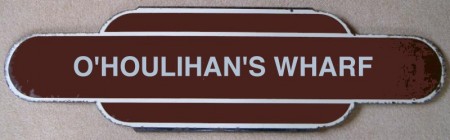
And so, finally, to the benighted fishing village itself, O’Houlihan’s Wharf. For obvious reasons, the timetables are less than accurate, but you should arrive within two or three weeks of setting out from Hooting Yard. You will be exhausted, and your head will be enveloped in steam, but you will I hope experience a Lovecraftian shudder as you step on to the platform, with the sudden, hideous realisation that there is no way back, and you must spend the rest of your days trudging up and down the rotting jetty, befouled seawater sloshing against your boots, and squalls blowing in from the west.

NOTE : Signage by OSM, to whom many thanks. The picture of the train on the cover of the brochure is from Agence Eureka.

Old Farmer Frack’s Haircut

Old Farmer Frack usually cut his own hair, hacking at it with a pair of shears, but one day he left his cows in the care of a hired urchin and strode to the nearest village to seek out a barber. There was no barber in the village, so Old Farmer Frack carried on along the lane until he came to another village. Here he found, not a barber, but a hairdresser. Unlike many hairdressing establishments, which are fond of punning names such as Hair Apparent or A Cut Above and so on and so forth, this one was called simply Rudimentary Hairdressing For Peasants, which suited Old Farmer Frack down to the ground.

He crashed in through the door, threw himself into a chair, and as the mildly startled hairdresser tucked a sheet around him, he bellowed that he wanted a “chop suey”.

The hairdresser had no idea what this mad old farmer was talking about and tried to explain that the only haircut available was a rudimentary one suitable for a peasant.

Old Farmer Frack shouted that as far as he was concerned, a “chop suey” was a basic haircut, and commanded the hairdresser to get on with it.

Hairdressers are not cows, however, and are much less tractable. This particular hairdresser took much pride in her work, and was not about to embark upon a haircut the lineaments of which she was ignorant. So she asked Old Farmer Frack to describe the “chop suey”. As farmers go, Old Farmer Frack was a highly intelligent man with an acute visual sense and a more than serviceable vocabulary, but he was also mad, so in reply to the hairdresser he blathered a scarcely intelligible farrago of nonsense. So persuasive was his tone of voice, however, that the hairdresser was spellbound and convinced that she actually had some understanding of what he was saying. No sooner had he shut his trap than she hacked at his hair with a pair of pruning shears, for all the world as if she had been practising the “chop suey” for years.

Old Farmer Frack was well pleased with the result, gave the hairdresser a generous tip in addition to the cost of the haircut, crashed out through the door and wended his way jauntily back to his cows.

Several days later, stories appeared in the local newspapers reporting that “an apparition of the late novelist Anthony Burgess has been seen stalking the lanes of our bailiwick”.

For the awful truth was that Old Farmer Frack’s “chop suey” could easily be mistaken for the preposterous Mancunian polymath’s haircut, memorably described by his biographer Roger Lewis as follows: And how are we going to describe his hair? The yellowish-white powdery strands were coiled on his scalp like Bram Stoker’s Dracula’s peruke, not maintained since Prince Vlad the Impaler fought off the Turks in the Carpathian mountains in 1462. What does it say about a man that he could go around like that, as Burgess did? Though he was a king of the comb-over (did the clumps and fronds emanate from his ear-hole?), no professional barber can be blamed for this. I thought to myself, he has no idea how strange he is. What did he think he looked like? He evidently operated on his own head with a pair of garden shears.

The Legend Of The Golden Pig

The circumstances in which I first heard the legend of the golden pig were oddly similar to those of the Sermon on the Mount. Crushed in a multitude, I followed a beardy man up on to a hillock, and sat down and listened to him speak… well, more or less. There were two or three of us, rather than a heaving mass of humanity, it was a flat field, not a hillock, and we did not listen to a beardy man speaking to us directly but to the disembodied voice of a woman, broadcast from a radio set perched on the back of a farmer’s cart. The voice belonged to the Woman Of Twigs, the radio set was pneumatic, and the cart belonged to mad Old Farmer Frack. It was his field we gathered in, and it was partially flooded.

There was no sign of the horse we assumed must have pulled the cart into the middle of the field. Old Farmer Frack only had one horse, named Desmond, so it was likely he had led it off along the lane to the fruit and nut market. It seemed he planned to leave the cart in the field for some time, for its wheels had been removed. I had seen the cart before, so I knew that they were the big wheels of Motown, to where, at a guess, they were being returned. There were wheels within wheels, too, and it had to be assumed they were also bound for Motown.

My companions and I found a patch of field relatively free of puddles and crouched in the muck to listen to the voice of the Woman Of Twigs. It was hard to tell whether it was a live broadcast or had been pre-recorded, and the reception from the pneumatic radio set could have been better. Buffeting winds howling across the flat landscape caused interference, and we had to take off our densely-knit waxed woollen hats and prick up our ears. We were glad about the winds, though, for they kept spinning the sails of the windmills on Pang Hill. Unlike the windmills of your mind so memorably sung about by Rex Harrison’s son Noel, the Pang Hill windmills were proper windmills, and on days when the air was still and their sails creaked to a halt there was something ineffably sad about them.

Ineffably sad, too, was the cracked and desolate voice of the Woman Of Twigs as she told the legend of the golden pig, which was what we had come to the field to hear. Old Farmer Frack had sent out a circular a fortnight earlier, to announce this cultural event. It was a welcome interruption to the unremitting tedium of our rustic malaise, as thrilling in its way as the visit of the travelling cinematograph the previous year, when we had been treated to a showing, in a different but no less sodden field, of the first and second reels of Ivan Reitman’s classic picture My Super Ex-Girlfriend.

It was a mystery how mad Old Farmer Frack found the resources to provide us with such entertainments. He appeared to spend his entire time driving his bellowing cows from field to field, pointlessly, bellowing as he did so, but obviously there was another side to him which we did not see. It was hard to imagine him brokering deals in the offices of media moguls, his huge ox-like frame squashed into a tubular steel executive seating pod, poring over spreadsheets, but we supposed it must be so. The Advanced Powerpoint Presentation Skills Certificate nailed up on the side of the cow byre and laminated to protect it from rainstorms was evidence that Old Farmer Frack had an inner management pointyhead to whom he occasionally gave vent.

The same could not be said of the Woman Of Twigs. She seemed to hail from an entirely other world, remote and ancient and savage. I once read an exciting, and completely comprehensible essay in The Very Difficult Journal Of Postmodernist Impenetrability entitled “Pippy The Pony And Twee Transgressive Hermeneutics In Narratives Of The Other”, hoping that I might gain some insight into the frankly bewildering nature of the Woman Of Twigs, but I was disappointed. The laugh-a-minute text, or discourse, had nothing in it to help me understand a weird, immensely tall crone draped in a burlap shift, with countless twigs stuck in her mop of matted ghost-white hair. My time was not entirely wasted, however, as the essay contained an astute and devastating analysis of Rawson Marshall Thurber’s film Dodgeball, which I hope to see one day if Old Farmer Frack is able to bring the travelling cinema back to one of his fields.

I was mildly perplexed that the Woman Of Twigs had chosen not to appear in person to tell us the legend of the golden pig. Until recently she had been a familiar sight in our bucolic paradise, tottering about by the horse-trough or standing majestic and windswept in the middle of the moors. Certain spiteful gossips put it about that she had taken the Murdoch shilling and was due to host a breakfast-time chatshow on Sky. I hoped that was not true, and it indeed turned out to be a falsehood, for which those responsible were tethered to a cement block on the village green and beaten with cudgels. Old Farmer Frack rented out the cudgels himself, which showed yet another side to this surprisingly kaleidoscopic mad old man. It remained the case, however, that no one had seen hide nor hair nor twig of the Woman Of Twigs for weeks. Where she dwelt had always been an unfathomable mystery, so it was not a simple case of bashing her door down and clamping a bleeper round her ankle as we would normally do with aged solitaries.

Still, crouched in the field listening to the pneumatic radio blaring and crackling from Old Farmer Frack’s cart, it was good to hear her voice. I was unfamiliar with the legend of the golden pig, and I thank my lucky stars that I was not told it when I was tiny, for it is without doubt the most absolutely terrifying story I have ever heard.

A New Com

One might think we had enough coms to be going on with. We already have sitcoms and romcoms and divcoms and dotcoms – respectively, situation comedies, romantic comedies, The Divine Comedy by Dante, and comedies about dotterels, the small wading bird of the plover family which breeds in the arctic tundra. So it might be argued that yet another com is a com too many. Normally, I would agree, were it not that the latest com is the frackcom, a series of comedies about Old Farmer Frack. As these are chiefly written by the bestselling paperback author Pebblehead I suppose they might equally well be called pebcoms. No doubt one or other term will win out as the common usage, much as we say “ping pong” rather than “gossima”, and “lawn tennis” rather than “sphairistike”.

It could be argued that there is little humour to be found in the perpetual trudgings of a mad old farmer driving his bellowing cows from field to field, pointlessly, in all weathers, through all the hours god sends. In fact, that is a view I have myself favoured, as explicated thoroughly in my six-part television series Penitence And Farm Implements, which insists that farmyard life is miserable and grim and despondent and hateful and wretched and disgusting and absolutely without comic possibility. But I reckoned without the skills of Pebblehead, whose hilarious accounts of Old Farmer Frack driving his bellowing cows from field to field, pointlessly, have me slapping my sides and gasping for breath.

The original books, of course, are known as farmyardlit, and it is the films and TV series based upon them that are called frackcoms or pebcoms. It is important to get this terminology right.

Civic Platform

Yesterday I mentioned Donald Tusk’s Civic Platform, and I am reminded that for a long time now there has been talk of creating a Hooting Yard Civic Platform. Unfortunately, the discussions have been mired in disagreement, unintelligibility, hysteria and pomposity, but perhaps it is time to let bygones be bygones and crack on with the job. Any future Hooting Yard Civic Platform will be robust rather than weedy, and it will be fit for purpose. Those are really the only two things we need to bear in mind, for all else is “as a vapour of haze in a mist of unknowing”, as Mrs Gubbins put it the other day, while talking in her sleep. It is difficult to overstate the importance of Mrs Gubbins’ contribution to this project. The crone is nearly ninety now, and has very few teeth in her head, but she has been around long enough to see an impressive number of Platforms, both Civic and otherwise, come and go. Our Platform, when it is built, will rest on solid foundations, and we must thank her for that, even if she is likely to be taking an afternoon nap when we do so.

I had hoped to bring on board a squad of zonk-eyed Milibands to kick-start this new, energetic phase of Civic Platform development, but Mrs Gubbins’ head turned green and septic when this idea was mooted, so I abandoned it. Instead, I got a pot of paint and daubed NOT WEEDY, ROBUST on a makeshift proto-Platform donated by Old Farmer Frack. Apparently it is made out of bits of a cow byre that he smashed up one night, but it serves its purpose admirably and looks very civic, plopped in the middle of a field rife with bracken. Mrs Gubbins, whose head is thankfully back to normal, has planted some nettles thereabouts, to add what she calls “a dash of Spartan rigour” to the scene. Whether the Spartans made use of nettles in such a way is not something I know about, and nor I suspect does La Gubbins, but it is always best to humour her fancies.

Attractive as the proto-Platform is, it lacks a certain coherence, for it remains unclear what kind of initiatives and policies will be launched from it. And believe you me, I intend the Hooting Yard Civic Platform to be a launch pad for a bewildering number of initiatives and policies. That is why a particularly damp and gloomy cellar in Pang Hill Orphanage will be the headquarters, soon I hope, of the Pang Hill Orphanage Think Tank, from which ideas will fizz. It would already have been set up had I been able to bash into Old Farmer Frack’s head the notion that, as a mad bellowing rustic, he is not a suitable candidate to be the Think Tank’s Director. He has his heart set on the position, bless him, even though it does not involve cows, but I am hoping to fob him off by making him an Honorary Patron.

Which brings me neatly to the main point of this otherwise witless bibblydib, which is that you too can apply to sit alongside Old Farmer Frack at the snackbar counter reserved for Honorary Patrons of the Hooting Yard Civic Platform. To be considered for this unbearably thrilling way of spending your twilight years, all you need to do is to complete the following sentence in no more than ten thousand words: “I will prove to be a robust rather than weedy patron of the Hooting Yard Civic Platform, because my first priority will be…”

Mrs Gubbins will sort through all the entries posted in Comments over the next couple of weeks, in between naps and nettle husbandry.

The Huffington Post

Whenever bumpkins gather of an evening in the shack at the end of the lane, sooner or later their talk will turn to the Huffington Post. It is not uncommon for the peasantry to fixate upon minutiae, of course. We think of Old Farmer Frack, obsessed with his bellowing cows, or the eerie barn at Scroonhoonpooge, or any number of pig-related outbreaks of countryside mass hysteria, often focussed upon something as insignificant as the shape of a newborn pig’s snout or trotters. Yet the bumpkins’ preoccupation with the Huffington Post was curious, for to the untrained eye it looked like any other fencepost or stake or piece of paling. I dare say you or I would pass by that post without giving it a glance, and the prattle of the bumpkins of an evening in the shack at the end of the lane would sound to us nonsensical. But rustic wisdom is hard won, and only a fool would dismiss the bumpkins’ shack chatter as drivel.

On a balmy evening one such fool blundered into the shack at the end of the lane and, hearing the bumpkins bandying the profundities of Huffington Post lore, took it for the idiocy of defectives. With his briefcase and bowler hat it was clear the fool dwelt in a city. Clear, too, that he could not tell the Huffington Post from any other posts and stakes and pales thumped into the muck for fencing the fields. His manner and his smirks were disparaging of the bumpkins, and when he left the shack and was making his way to the railway station, they waylaid him and carried him off to the eerie barn at Scroonhoonpooge. And as they had done with others who came to mock, they coated him in farmyard slurry and tar and poked him with pitchforks, and when they were done with him they buried him at midnight under the Huffington Post.

Old Farmer Frack

I have received a number of letters asking me to give some account of Old Farmer Frack. It is true that he was a mad old man, probably due to ergot poisoning. But he could be surprisingly lucid, too. For a time he employed a professional voice coach, more used to working with thespians, to help him develop exciting new roars and bellows. His cows were much given to bellowing, and Old Farmer Frack wanted to be able to bellow back in a way they would understand.

The voice coach was Satnav Gobgag, scion of the Bulgarian aeroplane manufacturing dynasty, whose huge hangars on the outskirts of Plovdiv were the site of tremendous aeronautical innovation during the interwar years. Satnav was a great disappointment to his parents and grandparents and great-grandparents, for despite receiving a first class education in the kinds of things that would make anyone fit to head an aeroplane-building business, he turned his back on the family firm and devoted himself to the questionable career – questionable in Bulgaria at that time, anyway – of drilling drama-struck misters and misses in the art of projecting their voices, be they dulcet or stentorian. It has been said that no one took to the stage of the Plovdiv Theatricum in the middle years of the last century who had not learned their stuff from Satnav Gobgag.

Exiled after the war to the country where Old Farmer Frack herded his tubercular cows, and by now grey and stooped and often covered in crumbs and dust, Satnav Gobgag fetched up at a ruined hotel on the seafront at Cack. He was only thirty-four, but looked to be twice that age, such had been his privations. It is well worth avoiding such privations if one can, but Satnav did not have the benefit of hindsight. Cut off without a penny by the Gobgag clan, accompanied in his exile by his pet coot, Satnav was on the point of starvation when into his hotel one day wandered Old Farmer Frack.

Q – What was the mad old man doing there, so far away from his cows?

A – He was in Cack to collect bags of sand, and stopped in at the hotel for a greasy breakfast, for he was fond of greasy breakfasts, but back at the farm usually made do with a dish of cowfeed.

Q – For what purpose did Old Farmer Frack need bags of sand from the beach at Cack?

A – To forestall, or avert, the flooding of his barns.

The pair struck up a conversation in the breakfast room of the hotel. And of what did they speak, this ill-matched duo? Why, they chattered away about the single topic that was convulsing the citizenry of Cack in those dark days, namely the invasion of an army of killer moorhens which was sweeping through the town in wave after wave of destructive mayhem. Satnav’s poor coot was cooped up in his hotel room for its own protection, and the penniless voice coach was frantic with fear what would happen to it when, as must surely soon happen, he and his coot were tossed out on their ears for non-payment. He reckoned without the lackadaisical approach of the hotel manager, Grimes, who affected a foppish disregard for such niceties as money. So long as his chef cooked up a greasy breakfast, and there were petunias in the plant pots, Grimes was happy to lean against the wall in the lobby flicking ash onto the tiles from the Norwegian cigars he had specially flown in. By coincidence, his smokes arrived once a month on an aircraft of Gobgag manufacture.

Old Farmer Frack was temperamentally blind to any animals except his cows, so his brain was perplexed by this talk of moorhens. He kept trying to change the subject, without success. After a while, he sat back in a daze, hypnotised by his companion’s mellifluous fluting, high-pitched jabbering, booming ostinato, silky whispers, and impeccable diction, for Satnav was deploying all of his vocal talents in describing the terrible sight of a thousand murderous moorhens tramping relentlessly towards the shopping arcade. It was when he made a noise like a cow that Old Farmer Frack sprang out of his seat, grabbed him roughly by the collar, and demanded that he repeat his bovine bellowing. Shortly thereafter, a deal was struck between the two men. Satnav Gobgag fetched his coot, and his paltry luggage, from his room, and accompanied Old Farmer Frack aboard his cart as they trundled off along meandering lanes to the farm.

Within days, the mad old fool was having rewarding conversations with his cows. He bellowed at them and they bellowed back. As he herded them from field to field, purposelessly, through all hours of the day and night, his voice coach reclined on a rickety sofa improving his English with a thorough reading of Dobson pamphlets while his coot plashed happily in Farmer Frack’s pond.

The idyll could not last. One autumnal day, when fallen leaves from the pugton trees so clogged the pond that the coot stayed indoors, there came a hammering at the door. Old Farmer Frack was miles away, in the furthest of his fields, though a faint bellowing could be heard when the wind died down. The coot, still nerve-wracked from its sight, through the hotel window, of lethal moorhens, trembled. Satnav Gobgag dropped his pamphlet – I think it was Dobson’s Some Remarks On The Grotesque Pallor I Encountered This Morning In My Shaving Mirror (out of print) – and strode in his brave Bulgarian way to the door. Opening it, he was astonished to find Grimes, the hotelier of Cack, florid with rage and somehow deeply threatening in a windcheater the colour of custard and a stout pair of wellington boots. All foppishness gone, Grimes had come to demand money. So much money, in fact, that Satnav pictured himself doing the washing up in the unsavoury hotel kitchen for the next forty years.

Q – Had something happened to Grimes to make him suddenly mindful of the unpaid bills of his hotel guests?

A – Yes. He received a clonk on the head from a piece of falling masonry.

Q – Had he tracked down other past guests, or did he have some sort of vendetta against Satnav Gobgag?

A – The former. Grimes now spent his days on horseback, criss-crossing the land demanding money with menaces from those who had taken advantage of his formerly lax manner.

Q – What menaces did he threaten?

A – Menaces so heinous they are unsuitable for family reading.

Q – What happened next?

A – Satnav Gobgag did the washing up in the unsavoury hotel kitchen for the next forty years. His coot remained on the farm, where he visited it every other weekend until it perished. Old Farmer Frack, having learned as much bovine bellowing as he needed, continued to be mad, and bellowing, and his cows bellowed back at him, for ever and ever, Amen.

Wrecks

There is huge excitement at Bodger’s Spinney as we look forward to this weekend’s annual Spinney Wreck Competition. Rival teams have been preparing for months, in utmost secrecy, their re-enactments of The Wreck Of The Deutschland and The Wreck Of The Hesperus. As ever when the Jesuits meet the Hiawathas, there is a sense of age-old blood feud, and volunteer ambulance-based medicos wearing special armbands will be on the alert from before daybreak.

Old Farmer Frack’s cows will be mooching in a nearby field to add an air of bucolic charm, and Mrs Gubbins will again be wearing the referee’s chapeau. In an exclusive pre-contest interview she told our reporter, “I am hoping things pass off with due decorum, but I have made sure we have enough tourniquets on site this year. No one wants to see a repeat of the time we had to send urchins scampering off across the hills to Old Ma Bagshaw’s Bandage Shop.”

Mrs Gubbins was made referee-in-perpetuity after she single-handedly sent packing a gang of rogue Opium-Eaters who tried to sabotage the contest with a wholly inappropriate, because shipless, re-enactment of The Household Wreck.

The latest odds are available from the illegal gambling den behind the illegal butcher’s shop on the plaza.

The Parish Wolf

Last week we held a funeral service for the parish wolf, although none of us is sure if it is really dead. Its howling has not been heard for twelve years, though, and under our laws a death certificate can be issued for a missing wolf after just five years. The general feeling in the parish was summed up by the sexton in a notice nailed, Luther fashion, to the door of the church. Even in the absence of a corpse, it would be for the good of the parish if obsequies were held. This was the gist of his notice, though it was couched in the mighty prose he deployed even when writing nature notes for the parish newsletter, and he did not on any account use the word closure.

One reason the sexton is so persuasive is that his appearance and bearing are strongly reminiscent of the actor James Robertson Justice (1907-1975). This is no accident. Over the years, the sexton has worked hard to imitate that booming voice, and he has undergone cosmetic surgery the better to ape the appearance of the man who, when not appearing in films, kept busy as a naturalist, racing driver, and falconry expert.

jamesrobertsonjustice.jpg

Before dawn on the morning of the funeral there was a teeming downpour. The rain had ceased by the time we gathered in the churchyard, but the pugton trees were drenched, water droplets dripping from the tiny grey spongy buds, each bud like the brain of a homunculus. An extraordinary number of puddles had formed on the paths, and there are many paths converging on St Bibblydibdib’s, for it is the only church for miles around, all others having been smashed to ruination by the sexton’s predecessor, single-handedly. He was twice the size of the present incumbent, a titan among sextons, and a brute, and the parish has been much quieter since he wilted away and was carted off to a mercy home. No ducks plashed in the puddles, for word had not yet reached them that the parish wolf was dead, or at least thought to be dead, and no duck dared come near for fear of being torn to bits.

I had been asked to read the obsequies, and had prepared what I thought was a pretty speech. I have a weakness for alliteration, and made use of lots of W words, describing the parish wolf as winsome and windswept and waterlogged and wiry and woebegone and witless. There was little truth in any of this, for the signal fact about the wolf was that it was, for the most part, invisible. Kim Fat Goo, the village bus driver, claimed to have seen it crossing the road once or twice, and the preposterous tabloid astrologer Jonathan Cainer, who once spent a week holed up in Old Ma Brimstone’s Bed And Breakfast establishment, said that the wolf paid him nocturnal visits in his dingy room, but few of us gave these tales any credence. Yet despite remaining unseen, the wolf was – or had been – a mighty presence in our parish, and I felt it deserved a memorable send-off, with all those W words, even if what I said was inaccurate.

Our vicar had been abducted by a cadre of rogue Tundists and was tied up in a turret somewhere, so the sexton took charge of the service. When it came my turn to speak, no sooner had I propped my notepad on the lectern and cleared my throat than there came a bellowing of cows from the fields adjoining the church. My words were drowned out. The cows bellowed all day and all night and into the next day, for they were Mad Old Farmer Frack’s cows, and there were hundreds of them, massive and ungainly and bellowing. The funeral broke up in disarray, and we repaired to a hangar at the village airfield, and we ate cake and macadamia nuts under the shadow of gigantic propellers, and when we emerged, look!, ducks populated the puddles. The parish wolf was dead and gone.